
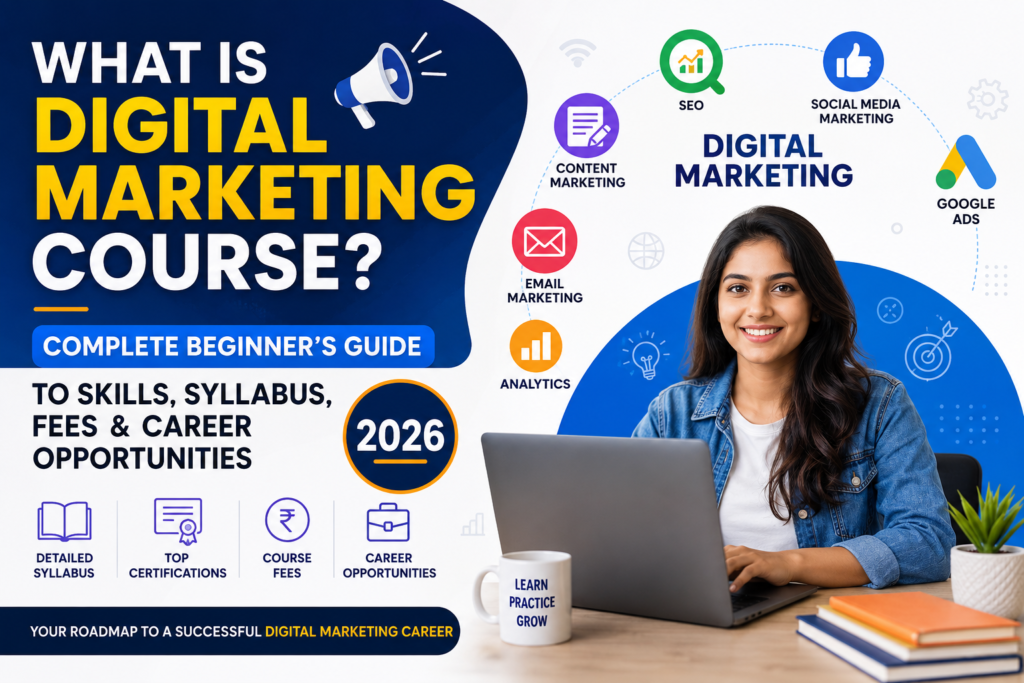
What Is Digital Marketing Course? (Featured Snippet)
A Digital Marketing Course is a structured training program that teaches you how to promote products, services, or businesses online using digital platforms such as Google, social media, websites, email, and search engines. A complete digital marketing course covers essential skills like Search Engine Optimization (SEO), Google Ads, Social Media Marketing, Content Marketing, Email Marketing, Web Analytics, AI tools, and lead generation, preparing learners for jobs, freelancing, entrepreneurship, or business growth.
Introduction
What Is Digital Marketing Course? If you’re searching for the answer, you’re probably considering a career in digital marketing, looking to grow your business online, or simply curious about one of the fastest-growing industries in the world.
Today, almost every business—whether it’s a local shop, a startup, or a multinational company—depends on digital marketing to reach customers. People spend hours every day browsing Google, watching YouTube, scrolling Instagram, using Facebook, shopping online, and reading blogs. Businesses want to reach these audiences where they spend their time, creating an enormous demand for skilled digital marketers.
This growing demand has made Digital Marketing Courses one of the most popular career-focused learning programs in recent years. Whether you’re a student, fresher, working professional, freelancer, entrepreneur, or business owner, learning digital marketing can open the door to exciting career opportunities, flexible work options, and even your own online business.
Unlike many traditional courses that focus heavily on theory, a quality digital marketing course emphasizes practical learning. You’ll work with real-world tools, create marketing campaigns, optimize websites, analyze customer behavior, and learn strategies used by successful brands.
The best part? You don’t necessarily need a technical background or programming knowledge to get started. Most beginner-friendly digital marketing courses are designed for learners from any educational or professional background.
In this complete beginner’s guide, you’ll learn:
What a Digital Marketing Course is
Why digital marketing is one of the best careers in 2026
Who should enroll in a digital marketing course
Eligibility criteria
Course duration
Complete syllabus
Skills you’ll learn
Course fees
Career opportunities
Salary expectations
Top certifications
Advantages and disadvantages
Tips for choosing the best digital marketing course
Frequently asked questions
If you’re serious about building a future-proof career or growing your business online, this guide will help you make an informed decision.
What Is Digital Marketing Course?
A Digital Marketing Course is a professional training program designed to teach individuals how to market products, services, or brands using digital channels. Instead of relying only on traditional advertising methods like newspapers, television, or billboards, digital marketing focuses on reaching customers through the internet.
The course introduces learners to different online marketing strategies that businesses use to attract visitors, generate leads, increase sales, and build long-term customer relationships.
In simple words, a digital marketing course teaches you how businesses grow online.
Whether you want to work for a company, become a freelancer, start a digital marketing agency, or promote your own business, these courses provide the knowledge and practical skills needed to succeed.
Why Is Digital Marketing Important?
Think about your daily routine.
You probably:
Search for information on Google
Watch videos on YouTube
Scroll through Instagram or Facebook
Shop on Amazon or Flipkart
Read blogs before buying products
Receive promotional emails
Click on online advertisements
Every one of these activities involves digital marketing.
Businesses invest billions of dollars every year to appear in front of potential customers online. They need skilled professionals who understand how these digital platforms work and how to create marketing campaigns that generate measurable results.
That’s exactly what a digital marketing course teaches.
What Will You Learn in a Digital Marketing Course?
A complete digital marketing course covers multiple marketing disciplines. Instead of learning just one skill, you’ll develop expertise across several areas.
Some of the major topics include:
Module What You’ll Learn
Search Engine Optimization (SEO) Improve website rankings on Google organically
Google Ads Run paid advertising campaigns on Google Search and Display Network
Social Media Marketing Promote businesses using Facebook, Instagram, LinkedIn, X, and other platforms
Content Marketing Create engaging blogs, videos, and valuable content
Email Marketing Build customer relationships through email campaigns
Web Analytics Measure website traffic and campaign performance
Affiliate Marketing Earn commissions by promoting products online
E-commerce Marketing Grow online stores and increase product sales
AI in Digital Marketing Use AI tools to improve productivity, content creation, and campaign optimization
Marketing Automation Automate repetitive marketing tasks and customer communication
By the end of the course, you’ll understand how these channels work together to create a successful digital marketing strategy.
How Does a Digital Marketing Course Work?
Most modern digital marketing courses combine theory with hands-on practical training.
Instead of simply reading textbooks, you’ll work on live projects and industry-standard tools.
A typical learning journey includes:
Understanding digital marketing fundamentals.
Learning each marketing channel step by step.
Practicing with real campaigns.
Working on assignments and case studies.
Building your own website or portfolio.
Running SEO and advertising campaigns.
Learning analytics and reporting.
Completing capstone projects.
Preparing for certifications and job interviews.
This practical approach helps learners gain confidence and become job-ready.
Types of Digital Marketing Courses
There isn’t just one type of digital marketing course. Different programs are designed to meet different learning goals.
- Beginner Digital Marketing Course
Perfect for students, freshers, and anyone with no prior experience.
Focus areas include:
Digital marketing basics
SEO fundamentals
Social media marketing
Google Ads
Content creation
Email marketing
- Advanced Digital Marketing Course
Designed for professionals who already understand the basics and want to master advanced concepts.
Topics often include:
Advanced SEO
Conversion Rate Optimization (CRO)
Marketing Automation
Advanced Analytics
AI-powered marketing
Funnel optimization
Growth marketing
- Online Digital Marketing Course
Online courses allow learners to study from anywhere at their own pace.
Advantages include:
Flexible schedule
Lifetime access (in many cases)
Lower cost
Self-paced learning
Access to recorded sessions
This option is ideal for working professionals, freelancers, and students who need flexibility.
- Offline Classroom Course
Offline training provides face-to-face interaction with instructors and classmates.
Benefits include:
Classroom discussions
Live doubt-solving
Networking opportunities
Hands-on workshops
Personalized guidance
This format suits learners who prefer structured classroom environments.
- Certification Courses
Certification courses are shorter programs focused on specific digital marketing skills.
Popular certification topics include:
SEO
Google Ads
Social Media Marketing
Email Marketing
Analytics
AI Marketing
These courses help professionals upskill quickly and strengthen their resumes.
Real-World Example: How Digital Marketing Helps Businesses
Imagine a local bakery that wants more customers.
Without digital marketing, it might rely only on walk-in traffic or word-of-mouth referrals.
Now imagine the bakery uses digital marketing strategies:
It appears on Google Maps when people search for “bakery near me.”
It shares attractive photos of cakes on Instagram.
It runs Facebook ads for birthday cake orders.
It sends discount coupons through email.
It publishes blog articles about custom cakes.
It collects customer reviews to build trust.
It tracks visitor behavior using analytics tools.
As a result, the bakery reaches more customers, receives more online orders, builds brand awareness, and increases revenue.
A digital marketer is the professional who plans and manages these activities.
This simple example shows why businesses of every size are investing heavily in digital marketing today.
Why Are Digital Marketing Courses Becoming So Popular?
Digital marketing has become one of the most sought-after skills because it offers opportunities across almost every industry.
Here are a few reasons why more people are enrolling in digital marketing courses:
High demand for skilled professionals
Growing number of online businesses
Opportunities to work remotely
Freelancing and consulting options
Competitive salaries
Low barrier to entry
Continuous learning and innovation
Ability to start your own business or agency
Practical, job-oriented curriculum
Global career opportunities
As businesses continue to expand their online presence, the need for skilled digital marketers is expected to grow even further.
Common Beginner Mistakes to Avoid
⚠️ Common Mistakes
Choosing a course based only on price.
Ignoring practical assignments and focusing only on theory.
Expecting instant results without consistent practice.
Learning every topic at once instead of mastering the fundamentals.
Not building a personal portfolio while learning.
Avoiding certifications that validate your skills.
💡 Pro Tip
Learning digital marketing is similar to learning to drive a car—you won’t become confident by reading about it alone. The fastest way to improve is by applying what you learn. Create a simple website, optimize it for search engines, run small ad campaigns, write blog posts, and analyze your results. Practical experience is what employers and clients value most.
What’s Next?
Now that you understand What Is Digital Marketing Course and why it has become one of the most valuable career-oriented programs, the next step is understanding why learning digital marketing in 2026 can be a smart career decision. We’ll also explore who should join a digital marketing course and the eligibility criteria in the next part of this complete guide.
Why Learn Digital Marketing in 2026?
The digital world is evolving faster than ever before. Every year, businesses invest more in online marketing because that’s where customers spend most of their time. Whether someone wants to buy a product, find a local service, compare prices, or learn a new skill, their journey usually starts online.
This shift has created a huge demand for professionals with digital marketing skills. If you’re wondering whether it’s still worth learning digital marketing in 2026, the answer is yes—perhaps even more than before.
Let’s explore why.
- Digital Marketing Is One of the Fastest-Growing Career Fields
Businesses of every size now rely on digital marketing to reach their target audience.
These include:
Small local businesses
E-commerce brands
Hospitals
Educational institutions
Hotels
Restaurants
Real estate companies
Startups
Software companies
Manufacturing businesses
Freelancers and consultants
As more businesses go online, they need professionals who can help them attract visitors, generate leads, and increase sales.
This growing demand means there are thousands of opportunities available for trained digital marketers.
- AI Is Transforming Marketing—Not Replacing Marketers
Artificial Intelligence (AI) has become an essential part of modern marketing. AI tools can help generate content, analyze customer behavior, automate repetitive tasks, and improve campaign performance.
However, AI cannot replace strategic thinking, creativity, or business decision-making.
A successful digital marketer understands:
What content customers actually need
How to create marketing strategies
How to build a brand
How to optimize campaigns
How to analyze performance
When and how to use AI effectively
Think of AI as a powerful assistant—not a replacement.
The future belongs to marketers who know how to combine human creativity with AI-powered tools.
- High Demand Across Every Industry
Unlike many professions that are limited to specific industries, digital marketing skills are needed almost everywhere.
Industries actively hiring digital marketers include:
Healthcare
Education
Finance
Real Estate
Tourism
Hospitality
Fashion
Automobile
Technology
E-commerce
Entertainment
Government projects
NGOs
Sports organizations
This means you’re not restricted to one career path.
- Work From Anywhere
One of the biggest advantages of learning digital marketing is flexibility.
Many professionals now work:
From home
While travelling
As freelancers
As remote employees
As digital nomads
Since most digital marketing tasks only require a laptop and internet connection, location becomes much less important than your skills.
This flexibility is especially valuable for:
Students
Parents
Freelancers
Working professionals
Entrepreneurs
- Freelancing Opportunities
Many businesses cannot afford to hire full-time marketing teams.
Instead, they hire freelance professionals.
After learning digital marketing, you can offer services such as:
SEO
Google Ads
Facebook Ads
Content Writing
Website Optimization
Social Media Management
Email Marketing
Local SEO
Analytics Reporting
Freelancing allows you to work with multiple clients and build your own personal brand.
Many experienced freelancers eventually start their own agencies.
- Excellent Career Growth
Digital marketing offers faster career progression compared to many traditional jobs.
A typical career path looks like this:
Experience Typical Job Role
Beginner Digital Marketing Intern
1–2 Years Digital Marketing Executive
2–4 Years SEO Specialist / PPC Specialist / Social Media Executive
4–6 Years Digital Marketing Manager
6–10 Years Growth Marketing Manager
10+ Years Head of Digital Marketing / Marketing Director / Consultant
Your growth depends more on your skills and results than your educational background.
- Competitive Salaries
As businesses compete online, skilled professionals become increasingly valuable.
Factors affecting salary include:
Skills
Certifications
Experience
Industry
Location
Portfolio
Communication skills
Professionals with expertise in SEO, Google Ads, Analytics, AI tools, and performance marketing often command higher salaries.
- Start Your Own Business
Digital marketing doesn’t just help you find a job—it helps you build a business.
Business owners use digital marketing to:
Generate leads
Increase sales
Build brand awareness
Grow social media
Improve customer loyalty
Launch new products
Expand into new markets
Whether you’re running a clothing store, restaurant, coaching business, or online shop, digital marketing helps you reach more customers at a lower cost than many traditional advertising methods.
- Low Investment, High Return
Unlike many professional courses that require years of study and significant expenses, digital marketing can be learned within a few months.
You don’t need expensive equipment.
Most learners only need:
A laptop
Internet connection
Curiosity
Consistency
Practice
This makes digital marketing one of the most accessible career options available today.
- Continuous Learning Keeps the Career Exciting
Digital marketing is always evolving.
Search engines introduce new updates.
Social media platforms launch new features.
AI tools improve rapidly.
Consumer behavior changes.
Because of this, digital marketers continuously learn and improve their skills.
If you enjoy solving problems and adapting to change, you’ll likely enjoy this profession.
Top Benefits of Learning Digital Marketing in 2026
High industry demand
Flexible work options
Remote career opportunities
Freelancing potential
Entrepreneurial growth
Excellent salary prospects
Global job opportunities
AI-powered marketing skills
Low learning cost
Practical, future-ready profession
Who Should Join a Digital Marketing Course?
One of the biggest advantages of a digital marketing course is that it welcomes learners from almost every educational and professional background.
Unlike careers that require specialized degrees, digital marketing focuses primarily on practical skills.
Let’s see who can benefit the most.
- Students
Students can start learning digital marketing while completing school or college.
Benefits include:
Building practical skills early
Earning freelance income
Strengthening resumes
Improving internship opportunities
Understanding online business
Many students begin freelancing before graduation, giving them valuable real-world experience.
- College Graduates
Graduates often struggle to gain practical job skills.
A digital marketing course bridges this gap by teaching industry-relevant tools and strategies.
Popular degree backgrounds include:
B.Com
BBA
BCA
B.Sc.
BA
Engineering
MBA
Journalism
Hotel Management
No matter your academic background, digital marketing skills remain valuable.
- Freshers
Many companies prefer candidates with practical knowledge rather than only academic qualifications.
A digital marketing course helps freshers:
Build portfolios
Gain certifications
Work on live projects
Improve interview confidence
Become job-ready
This makes it easier to secure entry-level marketing roles.
- Working Professionals
Professionals often learn digital marketing to:
Switch careers
Earn promotions
Increase salary
Manage company marketing
Start side businesses
Marketing professionals, sales executives, HR managers, and business analysts can all benefit from digital marketing knowledge.
- Business Owners
Business owners don’t always need to become full-time marketers.
However, understanding digital marketing helps them:
Hire better agencies
Evaluate campaign performance
Reduce advertising waste
Generate more leads
Increase online visibility
Even basic knowledge can lead to better business decisions.
- Freelancers
Freelancers who already offer services like:
Graphic Design
Website Development
Video Editing
Copywriting
Content Writing
can significantly increase their value by adding digital marketing services.
Clients often prefer professionals who understand both design and marketing.
- Homemakers
Digital marketing offers flexible learning and working opportunities.
Homemakers can:
Learn online
Work from home
Build personal brands
Start online businesses
Offer freelance services
Manage social media accounts
This flexibility makes digital marketing an attractive career option.
- Entrepreneurs and Startup Founders
Every entrepreneur needs customers.
Digital marketing helps founders:
Launch products
Build communities
Generate leads
Improve customer engagement
Increase sales
Measure marketing ROI
Understanding digital marketing reduces dependence on expensive agencies.
- Sales and Marketing Professionals
Traditional marketing professionals can upgrade their careers by learning:
Performance Marketing
SEO
Paid Advertising
Marketing Automation
AI Marketing
Analytics
These modern skills increase employability and future-proof careers.
Is Digital Marketing Right for You?
Digital marketing may be a great career choice if you:
✅ Enjoy learning new technologies.
✅ Like solving problems.
✅ Are creative.
✅ Enjoy writing or communicating.
✅ Like analyzing data.
✅ Want career flexibility.
✅ Want remote work opportunities.
✅ Dream of freelancing.
✅ Want to start a business.
You don’t need to be an expert in every area on day one. Most successful digital marketers specialize after learning the fundamentals.
Eligibility for Digital Marketing Course
One of the most common questions beginners ask is:
“What qualifications do I need to join a digital marketing course?”
The good news is that digital marketing has very simple eligibility requirements.
Educational Qualification
Most beginner-level courses accept learners who have completed:
10th Standard
12th Standard
Graduation
Post Graduation
Some advanced certification programs may recommend graduation, but it is not always mandatory.
Technical Knowledge
You do not need:
Coding skills
Programming knowledge
Computer science degree
Basic computer knowledge is usually enough to get started.
Skills That Help
Although not mandatory, these qualities make learning easier:
Curiosity
Creativity
Communication
Basic English reading skills
Problem-solving ability
Willingness to practice
Remember, these skills can also be developed during the course.
Age Limit
There is no official age limit.
Learners may include:
Teenagers
College students
Working professionals
Homemakers
Retired professionals
As long as you’re willing to learn, age is not a barrier.
💡 Pro Tip
When choosing a digital marketing course, don’t focus only on certificates. Employers and clients are far more interested in what you can do than what certificate you hold. Prioritize courses that include live projects, case studies, portfolio building, internships, and practical assignments.
⚠️ Common Mistakes Beginners Make
Waiting until after graduation to start learning.
Choosing a course based only on low fees.
Ignoring practical projects.
Expecting quick success without consistent practice.
Learning tools without understanding marketing strategy.
Not building a personal website or portfolio.
Avoid these mistakes, and you’ll be much better prepared for a successful career.
Digital Marketing Course Duration
One of the most common questions beginners ask before enrolling is:
“How long does it take to complete a digital marketing course?”
The answer depends on the type of course you choose, your learning goals, and whether you’re studying full-time or part-time.
Some learners only want to understand the basics to grow their business, while others want to build a long-term career in digital marketing. Because of this, training institutes and online learning platforms offer different course durations.
Let’s explore the available options.
- Short-Term Digital Marketing Course (1–2 Months)
Short-term courses are designed for beginners who want to quickly understand the fundamentals of digital marketing.
These courses usually cover:
Introduction to Digital Marketing
Search Engine Optimization (SEO)
Social Media Marketing
Google Ads Basics
Content Marketing
Email Marketing
Basic Analytics
Best For
Students
Business owners
Freelancers
Working professionals
Beginners exploring digital marketing
Pros
Affordable
Quick learning
Flexible schedule
Great introduction to the industry
Cons
Limited practical exposure
Fewer live projects
Basic-level knowledge only
- Certificate Digital Marketing Course (3–6 Months)
Certificate programs are among the most popular choices because they provide a balance between theory and practical learning.
A good certificate course generally includes:
SEO
Google Ads
Meta Ads
Content Marketing
Email Marketing
Google Analytics
AI Marketing Tools
Website Creation
Live Projects
Best For
Freshers
College students
Career changers
Job seekers
Pros
Job-oriented curriculum
Practical assignments
Industry certifications
Portfolio development
- Diploma in Digital Marketing (6–12 Months)
Diploma courses provide deeper knowledge of digital marketing strategies and tools.
These programs often include:
Advanced SEO
Performance Marketing
Marketing Automation
E-commerce Marketing
Conversion Rate Optimization (CRO)
Lead Generation
AI-powered Marketing
Agency Management
Best For
Professionals
Entrepreneurs
Marketing executives
Business owners
Benefits
Advanced skills
Internship opportunities
Better placement support
Higher earning potential
- Advanced Digital Marketing Program (6–12+ Months)
Advanced programs are designed for learners who want to become industry experts.
They usually include:
Live client projects
Portfolio development
Internship
Interview preparation
Freelancing guidance
AI Marketing
Personal Branding
Marketing Strategy
Business Growth
These programs prepare learners for leadership roles and consulting opportunities.
Which Course Duration Should You Choose?
Learning Goal Recommended Duration
Learn the Basics 1–2 Months
Get Job Ready 3–6 Months
Career Change 6 Months
Freelancing 3–6 Months
Start an Agency 6–12 Months
Business Growth 2–4 Months
Pro Tip: Instead of choosing the longest course, choose the one that offers the best practical learning experience.
Digital Marketing Course Syllabus
The syllabus is the heart of any digital marketing course.
A high-quality course doesn’t just teach theory—it helps you master practical skills using real-world tools and live projects.
Below is a detailed overview of the most important modules included in a modern digital marketing course.
Complete Digital Marketing Course Syllabus
Module What You Will Learn Practical Skills
Digital Marketing Fundamentals Basics of online marketing Marketing strategy
Search Engine Optimization (SEO) Rank websites on Google Keyword research, on-page SEO
Google Ads (PPC) Paid advertising Search, Display & Video Ads
Social Media Marketing Grow businesses on social media Content planning & campaigns
Meta Ads Facebook & Instagram advertising Lead generation
Content Marketing Content strategy & blogging Blog writing & optimization
Email Marketing Email campaigns Automation & newsletters
Affiliate Marketing Commission-based marketing Affiliate promotion
Web Analytics Measure website performance Google Analytics reporting
E-commerce Marketing Promote online stores Product marketing
AI Tools AI-powered marketing Content & automation
Marketing Automation Automate workflows CRM & email automation
Freelancing Client acquisition Proposal writing
Personal Branding Build online authority LinkedIn & portfolio
Let’s understand each module in detail.
Module 1: Digital Marketing Fundamentals
Every learner starts by understanding the basics of digital marketing.
Topics include:
What is Digital Marketing?
Traditional vs Digital Marketing
Customer Journey
Marketing Funnel
Online Consumer Behavior
Digital Marketing Channels
Types of Traffic
Lead Generation Basics
Why This Module Matters
Without understanding the fundamentals, advanced marketing strategies become difficult to implement.
Module 2: Search Engine Optimization (SEO)
SEO is one of the most valuable skills taught in any digital marketing course.
SEO helps websites appear higher in Google’s organic search results without paying for ads.
Topics Covered
Introduction to SEO
Search Engine Basics
Keyword Research
Search Intent
On-Page SEO
Technical SEO
Off-Page SEO
Link Building
Local SEO
Image SEO
Video SEO
SEO Audits
Practical Activities
Optimize blog articles
Research keywords
Improve website speed
Fix SEO errors
Build backlinks
Analyze competitors
Career Opportunities
SEO Executive
SEO Specialist
SEO Analyst
SEO Consultant
Module 3: Google Ads (Pay-Per-Click Advertising)
Google Ads helps businesses appear at the top of search results through paid advertising.
Students learn how to create profitable advertising campaigns.
Topics Covered
Google Ads Interface
Keyword Targeting
Search Ads
Display Ads
Shopping Ads
Video Ads
Remarketing
Conversion Tracking
Campaign Optimization
Practical Learning
Students create live advertising campaigns and learn how to optimize budgets for better ROI.
Module 4: Social Media Marketing (SMM)
Social media platforms have become powerful marketing channels.
This module teaches how businesses build communities and generate leads through engaging content.
Platforms Covered
Facebook
Instagram
LinkedIn
X (Twitter)
Pinterest
YouTube
Topics
Social Media Strategy
Audience Research
Content Calendar
Organic Growth
Community Management
Influencer Marketing
Performance Tracking
Module 5: Meta Ads
Meta Ads focus specifically on advertising through Facebook and Instagram.
Students learn:
Campaign Objectives
Audience Targeting
Pixel Setup
Retargeting
Lookalike Audiences
Lead Generation Ads
Conversion Campaigns
Budget Optimization
Meta advertising is widely used by e-commerce businesses, service providers, and local businesses.
Module 6: Content Marketing
Content is often called the foundation of digital marketing because it helps attract, educate, and convert potential customers.
Topics Covered
Content Strategy
Blogging
SEO Writing
Copywriting Basics
Landing Page Content
Video Content Planning
Storytelling
Content Distribution
Practical Assignments
Write blog posts
Create website content
Develop content calendars
Optimize articles for SEO
Module 7: Email Marketing
Email remains one of the highest ROI marketing channels.
This module teaches how to communicate with customers effectively through email campaigns.
Topics Covered
Email List Building
Lead Magnets
Newsletters
Automation
Welcome Emails
Promotional Campaigns
Drip Campaigns
Email Personalization
A/B Testing
Skills You’ll Gain
Writing engaging emails
Improving open rates
Increasing conversions
Customer retention
Module 8: Affiliate Marketing
Affiliate marketing allows individuals to earn commissions by promoting products or services.
Students learn:
Affiliate Networks
Commission Models
Product Selection
Content Promotion
SEO for Affiliate Websites
Tracking Links
Performance Optimization
This module is especially useful for bloggers, YouTubers, and content creators.
Module 9: Web Analytics
Successful marketing depends on measuring results.
Analytics teaches learners how to understand website visitors and campaign performance.
Topics Covered
Google Analytics
User Behavior
Traffic Sources
Goals
Events
Conversions
Bounce Rate
Reports
Dashboards
Students learn how to make data-driven marketing decisions.
Module 10: E-commerce Marketing
E-commerce businesses require specialized marketing strategies.
Topics include:
Product Listing Optimization
Shopping Ads
Marketplace Marketing
Customer Retention
Product Launch Strategy
Conversion Optimization
Cart Recovery
Product Reviews
This module is highly valuable for online store owners.
Module 11: AI Tools in Digital Marketing
Artificial Intelligence is transforming digital marketing.
Modern courses teach learners how to use AI responsibly to improve productivity.
Popular applications include:
Content generation
Keyword research
Email drafting
Ad copy creation
Data analysis
Customer support
Workflow automation
Important Note
AI assists marketers—it does not replace strategic thinking or creativity.
Module 12: Marketing Automation
Automation helps businesses save time by handling repetitive tasks automatically.
Topics include:
CRM Basics
Customer Journeys
Automated Emails
Lead Scoring
Workflow Automation
Campaign Triggers
Automation improves efficiency and customer experience.
Module 13: Freelancing
Many learners join digital marketing courses with the goal of becoming freelancers.
This module teaches:
Finding clients
Building proposals
Pricing services
Client communication
Portfolio development
Project management
Payment handling
Freelancing skills can help create additional income streams alongside a full-time job.
Module 14: Personal Branding
Your personal brand helps establish credibility in the digital marketing industry.
Topics include:
LinkedIn Optimization
Portfolio Website
Blogging
Thought Leadership
Networking
Public Speaking
Online Reputation
A strong personal brand can attract recruiters, clients, and business opportunities.
Hands-On Practical Training
A quality digital marketing course should include practical experience such as:
Live Projects
Website Creation
SEO Audits
Google Ads Campaigns
Social Media Campaigns
Content Writing
Email Campaigns
Analytics Reporting
Case Studies
Portfolio Building
The more practical exposure you receive, the more confident you’ll become in applying your skills.
💡 Pro Tip
Before enrolling in any digital marketing course, ask for the complete syllabus. Compare it with the modules listed above. A course that skips essential topics like SEO, Google Ads, Analytics, AI Tools, or live projects may not fully prepare you for real-world digital marketing roles.
⚠️ Common Mistakes to Avoid
Choosing a course with an outdated syllabus.
Focusing only on theory instead of practical learning.
Ignoring AI tools and marketing automation.
Not practicing with live projects.
Completing the course without building a portfolio or personal website.
Skills You Will Learn in a Digital Marketing Course
A digital marketing course is much more than learning how to post on social media or run advertisements. It equips you with a combination of technical skills, creative abilities, analytical thinking, and business knowledge that employers and clients value across industries.
Whether you want to get a job, start freelancing, launch your own agency, or grow your business, these skills will help you achieve your goals.
Let’s explore the most important skills you’ll develop.
- Search Engine Optimization (SEO)
SEO is one of the core skills every digital marketer should master.
You’ll learn how to improve a website’s visibility on search engines like Google, helping businesses attract organic (free) traffic.
What You’ll Learn
Keyword Research
Search Intent
On-Page SEO
Technical SEO
Off-Page SEO
Local SEO
Link Building
SEO Audits
Competitor Analysis
Why SEO Matters
SEO generates long-term traffic without paying for every visitor. Businesses that rank well on Google often receive consistent leads and sales.
- Pay-Per-Click (PPC) Advertising
Paid advertising helps businesses generate instant traffic and leads.
You’ll learn how to create and optimize advertising campaigns across different platforms.
Skills You’ll Learn
Google Search Ads
Display Advertising
Shopping Ads
Video Ads
Meta Ads
Budget Management
Audience Targeting
Conversion Tracking
Campaign Optimization
A skilled PPC marketer knows how to maximize return on advertising investment (ROI).
- Social Media Marketing
Social media is no longer just about posting images—it’s about building communities and growing businesses.
You’ll learn how to market brands on platforms like:
Facebook
Instagram
LinkedIn
X (Twitter)
Pinterest
YouTube
Practical Skills
Content Planning
Social Media Strategy
Audience Engagement
Influencer Collaboration
Community Management
Performance Analysis
- Content Writing and Copywriting
Content is the foundation of successful digital marketing.
You’ll learn to create content that:
Educates readers
Builds trust
Improves SEO
Generates leads
Increases conversions
Content Formats
Blog Articles
Website Content
Landing Pages
Ad Copy
Email Campaigns
Product Descriptions
Social Media Captions
Good content helps businesses attract and retain customers.
- Google Analytics and Data Analysis
Successful marketers rely on data rather than assumptions.
You’ll learn how to measure:
Website Traffic
User Behavior
Conversion Rate
Bounce Rate
Traffic Sources
Campaign Performance
Customer Journey
Analytics helps marketers make informed decisions and continuously improve campaign performance.
- Website Creation Basics
Most digital marketing courses introduce learners to website creation using beginner-friendly platforms.
You’ll understand:
Domain Names
Web Hosting
WordPress Basics
Landing Pages
Website Structure
User Experience (UX)
You don’t need to become a web developer, but understanding websites makes you a better marketer.
- AI Skills for Digital Marketing
AI has become an essential part of modern marketing.
Instead of replacing marketers, AI helps improve productivity.
You’ll learn how to use AI for:
Content Ideas
Keyword Research
Email Drafting
Ad Copy
Image Generation
Customer Support
Marketing Automation
The key is learning how to combine AI efficiency with human creativity.
- Communication Skills
Digital marketers work with clients, teams, designers, developers, and business owners.
Strong communication skills help you:
Present ideas clearly
Understand client requirements
Write persuasive content
Manage projects
Build long-term relationships
Technical knowledge alone isn’t enough—communication is equally important.
- Marketing Strategy
A successful campaign starts with a solid strategy.
You’ll learn how to:
Define business goals
Identify target audiences
Create customer personas
Select marketing channels
Allocate budgets
Measure campaign success
Strategic thinking helps marketers make better decisions and achieve measurable results.
- Sales Funnel and Lead Generation
Digital marketing is ultimately about generating leads and sales.
You’ll understand how customers move through different stages:
Funnel Stage Objective
Awareness Introduce the brand
Interest Build curiosity
Consideration Educate potential customers
Decision Encourage purchase
Retention Build long-term loyalty
Understanding the sales funnel helps marketers create more effective campaigns.
Soft Skills You’ll Develop
Besides technical expertise, you’ll also strengthen valuable workplace skills.
These include:
Problem Solving
Critical Thinking
Time Management
Creativity
Adaptability
Teamwork
Project Management
Decision Making
Client Handling
These skills are valuable in almost every profession.
Digital Marketing Course Fees
One of the biggest questions learners have before enrolling is:
“How much does a digital marketing course cost?”
The answer depends on several factors, including:
Course duration
Learning mode
Institute reputation
Trainer experience
Certifications included
Internship opportunities
Placement support
Live projects
A low-cost course isn’t always the best option. Focus on the value and practical learning you’ll receive.
Average Digital Marketing Course Fees
Course Type Estimated Fees
Online Beginner Course ₹5,000 – ₹20,000
Online Professional Course ₹20,000 – ₹60,000
Offline Classroom Course ₹25,000 – ₹80,000
Advanced Digital Marketing Program ₹50,000 – ₹1,50,000+
Diploma in Digital Marketing ₹40,000 – ₹1,20,000
Certification Programs ₹2,000 – ₹30,000
Note: Fees vary depending on the institute, location, course depth, and additional benefits such as internships, mentorship, or placement assistance.
What Affects Course Fees?
Several factors influence pricing.
- Course Duration
Longer courses generally include:
More modules
Live projects
Internship opportunities
Advanced topics
Therefore, they usually cost more.
- Trainer Experience
Courses taught by experienced industry professionals often charge higher fees because learners benefit from real-world insights and practical guidance.
- Practical Training
Courses that include:
Live projects
Case studies
Portfolio building
Internship
Client projects
typically offer better value than theory-only programs.
- Certifications
Some institutes prepare students for globally recognized certifications, which can increase the overall course cost but also improve employability.
- Placement Assistance
Institutes offering:
Resume preparation
Mock interviews
Internship support
Job referrals
often charge premium fees because of the additional career services provided.
Should You Choose the Cheapest Course?
Not necessarily.
Instead of comparing only fees, compare:
Updated syllabus
Practical assignments
Trainer expertise
Reviews and testimonials
Live projects
Internship opportunities
Placement assistance
Student support
A slightly higher investment in quality training can provide significantly better career outcomes.
Online vs Offline Digital Marketing Course
Choosing between an online and offline digital marketing course depends on your learning style, schedule, and career goals.
Here’s a detailed comparison.
Feature Online Course Offline Course
Flexibility ⭐⭐⭐⭐⭐ ⭐⭐
Classroom Interaction ⭐⭐ ⭐⭐⭐⭐⭐
Self-Paced Learning ✅ Yes ❌ Limited
Networking Opportunities Moderate Excellent
Travel Required No Yes
Cost Usually Lower Usually Higher
Recorded Sessions Available Rare
Live Practical Sessions Depends on Institute Usually Available
Doubt Solving Live & Recorded Face-to-Face
Suitable For Working Professionals, Students Full-Time Learners
Advantages of Online Learning
Learn from anywhere.
Flexible schedules.
Lower fees.
Lifetime access (many courses).
Easy to revisit recorded lectures.
Ideal for busy professionals.
Advantages of Offline Learning
Better classroom interaction.
Immediate doubt resolution.
Networking with classmates.
Structured learning environment.
More discipline and accountability.
Which Option Is Better?
There is no universal answer.
Choose an online course if you:
Have a full-time job.
Prefer self-paced learning.
Live far from training institutes.
Want to save on travel expenses.
Choose an offline course if you:
Learn better in a classroom.
Prefer face-to-face interaction.
Need structured guidance.
Enjoy collaborative learning.
The most important factor is the quality of the curriculum and practical training, not the mode of delivery.
💡 Pro Tip
Before enrolling, ask the institute these questions:
Is the syllabus updated for 2026?
Will I work on live projects?
Are AI tools included?
Is internship support available?
Will I build a portfolio?
Are classes recorded?
Is placement assistance provided?
How many hours are dedicated to practical training?
The answers to these questions will tell you far more than the course fee alone.
⚠️ Common Mistakes to Avoid
Choosing a course based only on low fees.
Ignoring practical assignments.
Enrolling without reviewing the syllabus.
Believing that a certificate alone guarantees a job.
Not checking the trainer’s industry experience.
Failing to compare multiple institutes before making a decision.
Career Opportunities After a Digital Marketing Course
One of the biggest reasons people enroll in a Digital Marketing Course is the wide range of career opportunities it offers. Unlike many professions where your job options are limited to a specific field, digital marketing skills are required in almost every industry.
Whether you want to work for a multinational company, a startup, an advertising agency, an e-commerce brand, or even start your own business, digital marketing provides multiple career paths.
As businesses continue to invest in their online presence, the demand for skilled digital marketers is expected to grow even further in 2026 and beyond.
Why Digital Marketing Careers Are Growing
The internet has changed how people search, shop, and make purchasing decisions. Today, customers compare products online, read reviews, watch videos, and interact with brands on social media before making a purchase.
Because of this shift, companies are hiring professionals who can:
Increase website traffic
Generate quality leads
Improve online visibility
Build brand awareness
Manage advertising campaigns
Analyze marketing performance
Increase sales and revenue
These responsibilities create excellent career opportunities for trained digital marketers.
Top Career Opportunities After a Digital Marketing Course
Below are some of the most in-demand job roles available after completing a digital marketing course.
Job Role Average Annual Salary (India)* Experience Level Career Growth
Digital Marketing Intern ₹1.8–3 LPA Fresher High
Digital Marketing Executive ₹3–5 LPA 0–2 Years Excellent
SEO Executive ₹3–5 LPA Fresher Excellent
SEO Specialist ₹5–9 LPA 2–5 Years High
SEO Manager ₹8–15 LPA 5+ Years Excellent
Google Ads Specialist ₹4–9 LPA 1–4 Years High
PPC Expert ₹5–10 LPA 2–5 Years Excellent
Performance Marketing Executive ₹5–12 LPA 2–5 Years Very High
Social Media Executive ₹3–6 LPA Fresher High
Social Media Manager ₹6–12 LPA 3–6 Years Excellent
Content Writer ₹3–6 LPA Fresher High
Content Marketing Manager ₹8–18 LPA 5+ Years Excellent
Email Marketing Specialist ₹4–8 LPA 2–4 Years High
Affiliate Marketing Manager ₹5–12 LPA 3–6 Years Excellent
Marketing Automation Specialist ₹8–15 LPA Advanced Very High
Web Analytics Specialist ₹6–12 LPA 2–5 Years Excellent
E-commerce Marketing Executive ₹4–8 LPA 1–3 Years High
Growth Marketing Manager ₹10–20 LPA 5+ Years Excellent
Digital Marketing Consultant ₹8–25+ LPA Experienced Outstanding
Digital Marketing Manager ₹10–20+ LPA 5–8 Years Outstanding
Digital Marketing Head ₹20–40+ LPA 8–12 Years Leadership
Freelancer Income Varies Any Level Unlimited
Agency Owner Income Varies Experienced Unlimited
*Note: Salary ranges are approximate and can vary depending on your city, industry, company size, certifications, skills, portfolio, and experience.
Detailed Explanation of Popular Job Roles
- Digital Marketing Executive
This is one of the most common entry-level roles for beginners.
Responsibilities include:
Managing marketing campaigns
Website updates
SEO implementation
Social media management
Email marketing
Reporting campaign performance
This role helps beginners gain experience across multiple digital marketing channels.
- SEO Specialist
SEO Specialists focus on improving website rankings on Google and other search engines.
Daily responsibilities include:
Keyword research
On-page SEO
Technical SEO
Link building
Competitor analysis
SEO reporting
If you enjoy analytics and long-term strategy, SEO is an excellent career path.
- Google Ads Specialist
Google Ads Specialists manage paid advertising campaigns that generate leads and sales.
Their work includes:
Campaign setup
Keyword targeting
Budget management
Conversion tracking
Performance optimization
ROI analysis
Businesses value professionals who can generate measurable returns from advertising budgets.
- Social Media Manager
Social Media Managers help brands build relationships with customers through social platforms.
Typical responsibilities include:
Content planning
Community management
Influencer collaboration
Campaign management
Engagement tracking
Performance reporting
Creativity and communication are essential for this role.
- Content Marketing Specialist
Content marketers create valuable content that educates customers and supports business growth.
Tasks include:
Blog writing
Content strategy
SEO writing
Website copy
Video content planning
Content promotion
Strong writing skills are a major advantage.
- Performance Marketing Specialist
Performance marketers focus on measurable business results.
They optimize:
Paid advertising
Conversion rates
Customer acquisition
Sales funnels
Return on investment (ROI)
This specialization is highly valued because businesses can directly measure campaign performance.
- Marketing Automation Specialist
As companies grow, automation becomes increasingly important.
Automation specialists build systems that automatically:
Send emails
Score leads
Nurture customers
Track user behavior
Improve customer experience
This is one of the fastest-growing areas within digital marketing.
- Digital Marketing Manager
Managers lead marketing teams and oversee complete digital strategies.
Responsibilities include:
Campaign planning
Budget allocation
Team management
Client communication
Performance monitoring
Business strategy
This role combines technical expertise with leadership skills.
- Freelance Digital Marketer
Many professionals choose freelancing instead of traditional employment.
Freelancers offer services such as:
SEO
Google Ads
Meta Ads
Website Audits
Content Writing
Email Marketing
Social Media Management
Freelancing provides flexibility and the opportunity to work with clients worldwide.
- Digital Marketing Consultant
Consultants help businesses improve their online marketing strategies.
They typically:
Analyze business goals
Identify marketing problems
Develop growth strategies
Train internal teams
Improve campaign performance
Consultants often work with multiple companies across different industries.
Career Growth Roadmap
Digital marketing offers clear career progression for professionals who continuously upgrade their skills.
Experience Typical Position
0–1 Year Intern / Trainee
1–2 Years Executive
2–4 Years Specialist
4–6 Years Senior Specialist / Team Lead
5–8 Years Manager
8–12 Years Head of Digital Marketing
12+ Years Consultant / Agency Owner / Marketing Director
Unlike many traditional careers, promotions are often based on performance, results, and expertise rather than years of service alone.
Digital Marketing Salary in India
Your salary depends on several factors, including:
Experience
Skills
Certifications
Portfolio
City
Industry
Communication skills
Practical knowledge
Estimated Salary Progression
Experience Estimated Salary
Fresher ₹3–5 LPA
2 Years ₹5–8 LPA
3–5 Years ₹8–12 LPA
5–8 Years ₹12–20 LPA
8+ Years ₹20 LPA and above
Professionals with expertise in SEO, Performance Marketing, Analytics, AI, and Marketing Automation often command higher salaries.
Can You Earn Without a Full-Time Job?
Absolutely.
Many digital marketers generate income through:
Freelancing
Blogging
Affiliate Marketing
Consulting
YouTube
Selling Online Courses
Running a Digital Marketing Agency
Managing Social Media Accounts
SEO Services
Website Audits
Diversifying your income streams can increase financial stability and create long-term growth opportunities.
Top Digital Marketing Certifications
Certifications validate your knowledge and demonstrate your commitment to learning. While practical experience matters most, recognized certifications can strengthen your resume and improve interview opportunities.
Below are some of the most respected certifications available.
Certification Best For Skill Level
Google Ads Certification Paid Advertising Beginner–Advanced
Google Analytics Certification Web Analytics Beginner
HubSpot Content Marketing Certification Content Marketing Beginner
HubSpot Email Marketing Certification Email Marketing Beginner
Meta Certified Digital Marketing Associate Social Media Marketing Beginner
SEMrush SEO Certification SEO Intermediate
LinkedIn Marketing Labs Certification B2B Marketing Intermediate
Microsoft Advertising Certification PPC Advertising Intermediate
Shopify Academy Certifications E-commerce Marketing Beginner–Intermediate
Why Certifications Matter
A good certification can help you:
Validate your knowledge
Improve your resume
Increase interview confidence
Stay updated with industry trends
Demonstrate commitment to continuous learning
However, certifications should complement practical experience—not replace it.
Build a Strong Portfolio Alongside Certifications
Employers often ask:
“Can you show us what you’ve worked on?”
That’s why building a portfolio is just as important as earning certificates.
Include:
SEO Projects
Blog Articles
Google Ads Campaigns
Social Media Campaigns
Website Audits
Email Campaigns
Analytics Reports
Case Studies
A well-organized portfolio demonstrates your ability to apply your knowledge in real-world situations.
💡 Pro Tip
Don’t wait until you complete your course to build experience. Create your own website, start a blog, optimize it for SEO, run small marketing campaigns, and document your results. Real-world projects make your portfolio stronger and help you stand out in interviews.
⚠️ Common Mistakes to Avoid
Focusing only on certificates instead of practical skills.
Applying for jobs without a portfolio.
Ignoring communication and presentation skills.
Learning one specialization while neglecting the basics.
Stopping learning after completing a course.
Remember, digital marketing is an industry where continuous learning leads to continuous growth.
Advantages of Learning Digital Marketing
Digital marketing has become one of the most valuable professional skills in today’s digital-first world. Whether you’re looking for a stable career, planning to start your own business, or wanting to earn through freelancing, learning digital marketing offers several long-term advantages.
Let’s explore the key benefits.
- High Demand Across Industries
Digital marketing is no longer limited to technology companies. Almost every industry requires professionals who can promote products and services online.
Industries hiring digital marketers include:
Healthcare
Education
E-commerce
Banking & Finance
Real Estate
Hospitality
Travel & Tourism
Fashion
Manufacturing
Information Technology
Media & Entertainment
This wide demand creates numerous career opportunities.
- Multiple Career Options
Unlike many professions that follow a single career path, digital marketing allows you to specialize in different areas based on your interests.
Popular career options include:
SEO Specialist
Google Ads Expert
Social Media Manager
Content Writer
Content Strategist
Performance Marketer
Marketing Automation Specialist
Email Marketing Expert
Digital Marketing Consultant
Freelancer
Agency Owner
This flexibility helps professionals choose careers aligned with their strengths.
- Excellent Salary Growth
As you gain experience and develop specialized skills, your earning potential increases significantly.
Professionals with expertise in:
SEO
Performance Marketing
Analytics
AI Tools
Conversion Optimization
Marketing Automation
often receive higher salary packages due to the measurable impact they create for businesses.
- Work From Anywhere
One of the biggest advantages of digital marketing is location independence.
Many professionals work:
From home
While travelling
From coworking spaces
As remote employees
As freelancers
All you generally need is:
A laptop
Reliable internet connection
The right skills
- Low Investment, High Returns
Compared to many traditional professional courses, digital marketing is relatively affordable.
You don’t need expensive equipment or years of education to begin learning.
Instead, consistent practice and continuous learning help you grow.
- Freelancing Opportunities
Freelancing has become one of the most attractive career paths for digital marketers.
You can provide services such as:
SEO
Google Ads
Social Media Management
Content Writing
Website Audits
Email Marketing
Local SEO
Analytics Reporting
Freelancers enjoy flexibility in choosing clients, projects, and working hours.
- Opportunity to Start Your Own Business
Digital marketing is especially valuable for entrepreneurs.
Instead of depending entirely on agencies, business owners who understand digital marketing can:
Generate leads
Increase sales
Build brand awareness
Improve customer engagement
Reduce advertising costs
Measure marketing performance
These skills contribute directly to business growth.
- Continuous Learning Keeps You Relevant
Digital marketing evolves rapidly.
Search engines update their algorithms.
Social media platforms introduce new features.
AI tools become more advanced.
Customer behavior changes regularly.
Professionals who enjoy learning new technologies often find digital marketing exciting and rewarding.
- Global Career Opportunities
Digital marketing skills are relevant worldwide.
Businesses across different countries require professionals who understand:
SEO
Paid Advertising
Content Marketing
Analytics
Social Media
Marketing Automation
This opens opportunities to work with international clients and organizations.
- Practical Skills That Deliver Results
Unlike courses focused mainly on theory, digital marketing emphasizes practical application.
You’ll gain hands-on experience by:
Optimizing websites
Creating marketing campaigns
Analyzing performance reports
Writing content
Running advertisements
Building online strategies
These practical skills are immediately useful in the workplace.
Benefits of a Digital Marketing Course at a Glance
High industry demand
Diverse career options
Attractive salary potential
Flexible work opportunities
Freelancing possibilities
Entrepreneurial advantages
Global job prospects
Continuous learning
Practical skill development
Strong long-term career growth
Disadvantages of Learning Digital Marketing
Although digital marketing offers many benefits, it’s important to understand its challenges as well.
Knowing these realities helps you prepare for long-term success.
- Continuous Learning Is Essential
Digital marketing changes quickly.
Google updates search algorithms.
Advertising platforms introduce new features.
AI tools evolve rapidly.
Professionals must regularly update their knowledge to remain competitive.
- Results Take Time
Many beginners expect immediate success.
However:
SEO requires patience.
Brand building takes time.
Content marketing delivers long-term results.
Organic traffic grows gradually.
Consistency is the key to sustainable success.
- High Competition
As digital marketing becomes more popular, competition increases.
The best professionals continue improving their skills through:
Practice
Certifications
Real-world projects
Portfolio development
Networking
Continuous improvement helps you stay ahead.
- Client Expectations
Freelancers and agency professionals often work with demanding clients.
Strong communication, transparency, and realistic expectations are essential for maintaining long-term relationships.
- Information Overload
There are countless blogs, YouTube videos, courses, and tutorials available online.
Without a structured learning plan, beginners can become overwhelmed.
Following a well-designed course helps reduce confusion.
How to Choose the Best Digital Marketing Course
Selecting the right course is one of the most important decisions you’ll make.
A quality course should prepare you for real-world marketing—not just provide certificates.
Below is a practical checklist to help you evaluate different courses.
- Updated Curriculum
The course should include modern topics such as:
SEO
Google Ads
Meta Ads
AI Tools
Marketing Automation
Analytics
E-commerce Marketing
Content Marketing
Email Marketing
Avoid outdated courses that ignore recent industry trends.
- Practical Learning
Look for programs that include:
Live Projects
Case Studies
Assignments
Portfolio Development
Website Creation
Campaign Management
Practical experience is essential for becoming job-ready.
- Experienced Trainers
Research the instructors before enrolling.
Good trainers should have:
Industry experience
Practical expertise
Real client experience
Updated knowledge
Positive student feedback
Learning from experienced professionals often provides insights beyond textbooks.
- Internship Opportunities
Internships help learners:
Apply classroom knowledge
Build confidence
Gain workplace experience
Strengthen resumes
Institutes that offer internships provide additional value.
- Placement Assistance
If your goal is employment, check whether the institute provides:
Resume building
Mock interviews
Career guidance
Job referrals
Placement support
These services can make your job search more effective.
- Student Reviews
Before enrolling, research:
Google Reviews
Alumni testimonials
Success stories
LinkedIn profiles of former students
Authentic reviews offer valuable insights into course quality.
- Certifications Included
Check whether the course prepares students for recognized certifications such as:
Google Ads
Google Analytics
HubSpot
Meta
Microsoft Advertising
Industry-recognized certifications can strengthen your professional profile.
- AI and Emerging Technologies
Modern digital marketing increasingly relies on AI.
Choose a course that teaches learners how to use AI responsibly for:
Content Creation
Keyword Research
Automation
Campaign Optimization
Productivity
Ignoring AI may leave you behind in the future job market.
Digital Marketing Course Selection Checklist
Before paying for any course, ask these questions:
✅ Is the syllabus updated for 2026?
✅ Does the course include live projects?
✅ Will I build a professional portfolio?
✅ Are internship opportunities available?
✅ Is placement support provided?
✅ Are classes recorded?
✅ Are AI tools included?
✅ Are industry certifications covered?
✅ Is there practical campaign experience?
✅ Are trainers experienced professionals?
If the answer to most of these questions is “Yes,” you’re likely considering a quality course.
Is Digital Marketing a Good Career in 2026?
The short answer is Yes.
Digital marketing continues to grow because businesses are investing more in their online presence.
Several factors support this trend:
Increasing internet usage
Growth of e-commerce
Expansion of online education
Rising digital advertising budgets
AI-powered marketing tools
Demand for measurable marketing results
Companies need professionals who understand both technology and customer behavior.
Those who continuously learn and adapt are likely to enjoy excellent long-term career opportunities.
Who Will Benefit Most?
Digital marketing is a strong career choice for:
Students
Fresh Graduates
Career Changers
Working Professionals
Freelancers
Entrepreneurs
Small Business Owners
Content Creators
Regardless of your background, developing practical digital marketing skills can open new career opportunities.
💡 Pro Tip
Don’t try to master every specialization at once. Begin with the fundamentals, then choose one area—such as SEO, Google Ads, Social Media Marketing, or Content Marketing—to develop deeper expertise. Over time, expand your skills into complementary areas for even greater career growth.
⚠️ Common Mistakes to Avoid
Choosing a course based only on price.
Ignoring practical assignments.
Not building a portfolio.
Expecting instant success.
Skipping certifications.
Failing to stay updated with industry trends.
Learning without applying your knowledge through real projects.
Coming Up in Part 7
In the final part of this comprehensive guide, we’ll cover:
15 Frequently Asked Questions (FAQs)
People Also Ask (Google-Style Questions)
Internal Linking Suggestions
External Linking Suggestions
SEO Title
Meta Description
URL Slug
Open Graph (OG) Tags
Twitter Tags
Conclusion
FAQ Schema
Article Schema
Breadcrumb Schema
This final section will help make your article fully optimized for search engines and ready for publication.
Frequently Asked Questions (FAQs)
- What is a digital marketing course?
A digital marketing course is a professional training program that teaches you how to promote products, services, and businesses using online channels such as search engines, social media, email, websites, and paid advertising. Most courses include SEO, Google Ads, Social Media Marketing, Content Marketing, Email Marketing, Analytics, and AI tools.
- Who should join a digital marketing course?
A digital marketing course is suitable for:
Students
Fresh graduates
Working professionals
Business owners
Freelancers
Homemakers
Entrepreneurs
Anyone interested in building an online career
No technical background is required for beginner-level courses.
- What is the eligibility for a digital marketing course?
Most institutes do not have strict eligibility requirements. Anyone who has basic computer knowledge and an interest in online marketing can join. Courses are available for learners after the 10th, 12th, graduation, or even while working.
- How long does a digital marketing course take to complete?
The duration depends on the type of program:
Short-term courses: 1–2 months
Certificate courses: 3–6 months
Diploma courses: 6–12 months
Advanced programs: 6–12+ months
Choose a course based on your career goals rather than duration alone.
- What subjects are included in a digital marketing course?
A comprehensive digital marketing course typically covers:
Search Engine Optimization (SEO)
Google Ads (PPC)
Social Media Marketing
Meta Ads
Content Marketing
Email Marketing
Affiliate Marketing
Web Analytics
E-commerce Marketing
AI Tools
Marketing Automation
Personal Branding
Freelancing
- What skills will I learn in a digital marketing course?
You’ll develop practical skills such as:
SEO
Google Ads
Content Writing
Social Media Marketing
Email Marketing
Analytics
AI-assisted marketing
Website creation
Lead generation
Marketing strategy
These skills are highly valuable in today’s digital economy.
- What are the average digital marketing course fees in India?
Fees vary depending on the course type and institute.
Typical fee ranges are:
Online courses: ₹5,000–₹60,000
Offline courses: ₹25,000–₹80,000
Diploma programs: ₹40,000–₹1,20,000
Advanced programs: ₹50,000–₹1,50,000+
Always compare the syllabus, practical training, and placement support before enrolling.
- Is digital marketing a good career in 2026?
Yes. Digital marketing continues to be one of the fastest-growing career fields because businesses increasingly rely on online marketing to reach customers. Professionals with practical skills in SEO, paid advertising, analytics, and AI-assisted marketing are expected to remain in high demand.
- Can I learn digital marketing without coding?
Yes.
Most digital marketing roles do not require programming knowledge.
Basic computer skills, curiosity, creativity, and a willingness to learn are usually enough for beginners.
- Is digital marketing difficult to learn?
No.
Digital marketing is beginner-friendly when learned step by step. While mastering advanced concepts requires practice and continuous learning, the fundamentals are accessible to learners from almost any educational background.
- What jobs can I get after completing a digital marketing course?
Career opportunities include:
Digital Marketing Executive
SEO Executive
SEO Specialist
PPC Specialist
Google Ads Expert
Social Media Manager
Content Writer
Content Marketing Executive
Email Marketing Specialist
Performance Marketer
Digital Marketing Manager
Freelancer
Consultant
- What is the salary of a digital marketer in India?
Entry-level professionals generally earn around ₹3–5 LPA, while experienced specialists and managers can earn ₹10 LPA or more. Salaries vary depending on skills, certifications, location, industry, and experience.
- Can I do freelancing after learning digital marketing?
Yes.
Many digital marketers work as freelancers and offer services like SEO, Google Ads management, content writing, website audits, social media management, and email marketing to clients worldwide.
- Which certification is best for digital marketing?
Some of the most respected certifications include:
Google Ads Certification
Google Analytics Certification
HubSpot Certifications
Meta Certification
Microsoft Advertising Certification
SEMrush SEO Certification
Practical experience should always accompany certifications.
- Is an online digital marketing course better than an offline course?
Both options have advantages.
Online courses offer flexibility and affordability, while offline courses provide classroom interaction and networking opportunities. The quality of the syllabus, trainers, and practical training is more important than the learning format.
People Also Ask (Google-Style Questions)
What is a digital marketing course in simple words?
A digital marketing course teaches you how to promote products, services, and businesses online using platforms such as Google, social media, websites, email, and paid advertising.
Is digital marketing a good career after graduation?
Yes. Digital marketing is an excellent career choice for graduates because it offers practical skills, diverse career opportunities, freelancing options, and strong salary growth.
Can beginners learn digital marketing?
Absolutely. Most beginner-level courses are designed for learners with no prior experience and focus on practical, step-by-step training.
How much does a digital marketing course cost?
Course fees vary widely depending on the institute and course level, but beginner courses generally start from around ₹5,000, while advanced programs may cost over ₹1,00,000.
Which is the best digital marketing course?
The best course is one that includes an updated syllabus, experienced trainers, live projects, AI tools, internships, portfolio building, and placement support.
Does a digital marketing course guarantee a job?
No course can guarantee a job. However, high-quality training combined with practical experience, a strong portfolio, and recognized certifications can significantly improve your employment prospects.
Is digital marketing better than traditional marketing?
Digital marketing offers measurable results, targeted advertising, flexibility, and global reach. However, many successful businesses use a combination of digital and traditional marketing strategies.
Can I learn digital marketing from home?
Yes. Many learners successfully complete online digital marketing courses from home using a laptop, internet connection, and consistent practice.
Which specialization is best in digital marketing?
Popular specializations include:
Search Engine Optimization (SEO)
Performance Marketing
Google Ads
Social Media Marketing
Content Marketing
Marketing Automation
Web Analytics
The best choice depends on your interests and career goals.
Is AI replacing digital marketers?
No. AI is changing how marketers work by automating repetitive tasks and improving productivity, but human creativity, strategic thinking, and decision-making remain essential.
Conclusion
If you’ve been wondering “What Is Digital Marketing Course?”, the answer is simple: it’s one of the most practical and career-focused learning paths available today.
A well-structured digital marketing course equips you with in-demand skills such as Search Engine Optimization (SEO), Google Ads, Social Media Marketing, Content Marketing, Email Marketing, Analytics, AI-powered marketing, and lead generation. These skills can help you build a successful career, grow your own business, work as a freelancer, or even start a digital marketing agency.
The best part is that you don’t need a technical background to begin. With consistent practice, real-world projects, and a commitment to continuous learning, anyone can build a rewarding career in digital marketing.
As businesses continue to expand their online presence in 2026 and beyond, skilled digital marketers will remain in high demand. Choosing the right course, building a strong portfolio, and staying updated with industry trends will help you stand out in this competitive field.
Whether you’re a student, fresher, working professional, entrepreneur, or business owner, now is an excellent time to invest in digital marketing skills and prepare for the future.
Your learning journey starts with one decision—and the best time to begin is today.